


Founding Attorney
Letter of credit discrepancies are differences between the documents a beneficiary presents and the terms of the credit. When they appear, the bank may refuse to pay. Under UCP 600, the bank must examine the documents, decide within five banking days, and send one refusal notice listing every discrepancy, or it loses the right to reject.
For exporters, importers, and trade finance teams, discrepancies are not a rare mishap. Industry estimates suggest that 60% to 75% of first presentations contain at least one discrepancy. Consequently, every trading business needs a clear playbook for preventing, curing, and disputing documentary refusals. This guide explains the rules, the deadlines, and the legal options.
What Are Letter of Credit Discrepancies?
A letter of credit promises payment against complying documents, not against goods. Banks deal in documents alone. Therefore, examiners compare each document against the terms of the credit, the rules of UCP 600 published by the International Chamber of Commerce, and international standard banking practice. Any failure to conform is a discrepancy, and even small defects can justify refusal.
Courts apply a demanding standard of compliance. In Beyene v. Irving Trust Co., 762 F.2d 4 (2d Cir. 1985), a bill of lading named the notify party as Mohammed Soran instead of Mohammed Sofan. The Second Circuit held that the misspelling was a material discrepancy. As a result, the bank was entitled to refuse payment. The lesson is simple: nearly right is still wrong.
Common Types of Discrepant Documents
Most refusals involve a handful of recurring problems. For example, the most frequent letter of credit discrepancies include:
- Late shipment or late presentation. The transport document shows shipment after the latest date, or the documents arrive after the credit expires.
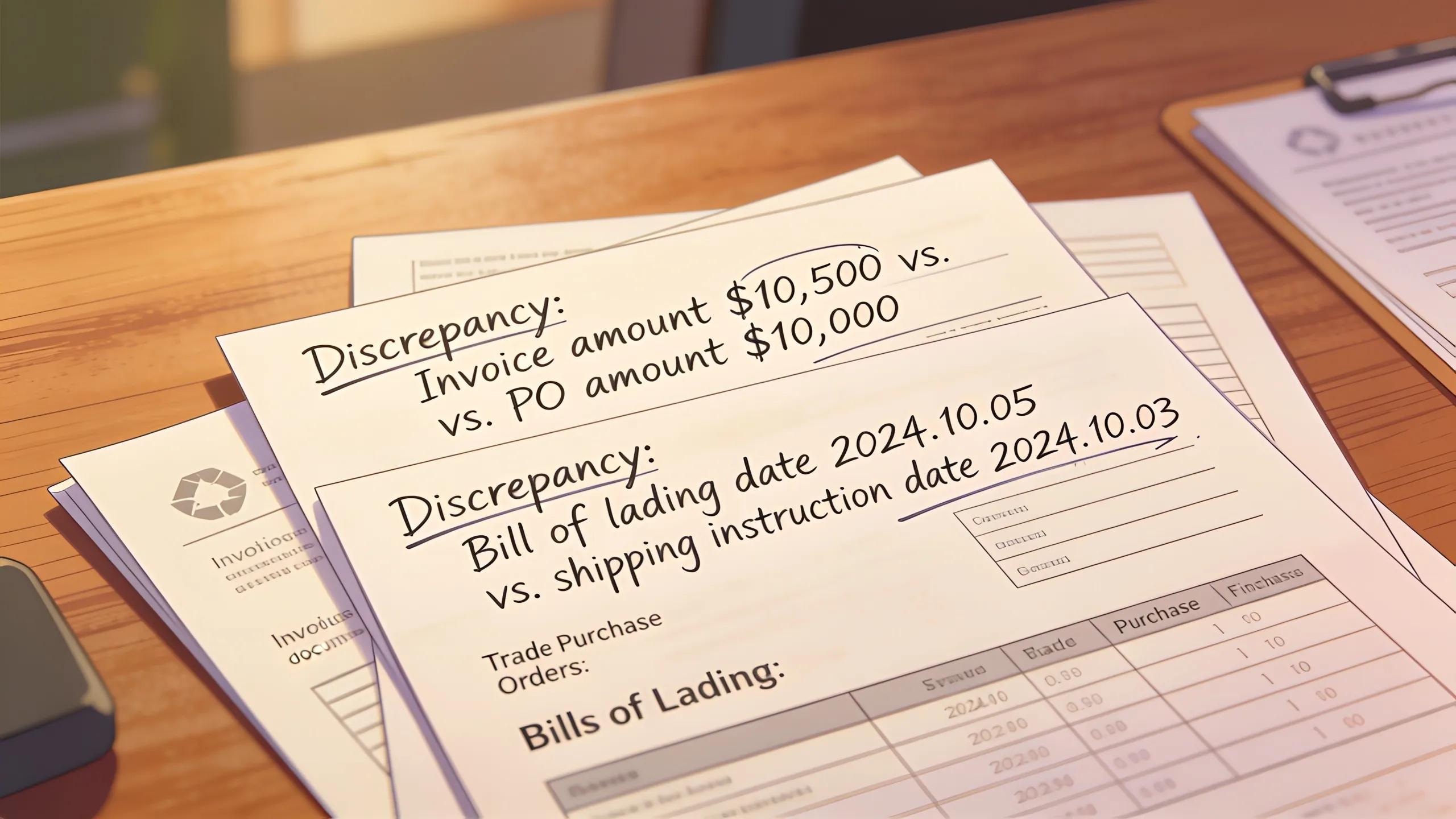
- Inconsistent data. The invoice, transport document, and insurance certificate conflict with each other or with the credit. Mismatched goods descriptions, amounts, or ports are classic examples.
- Missing or defective documents. A required certificate is absent, unsigned, or issued by the wrong party.
- Transport document problems. The bill of lading lacks an on-board notation, names the wrong consignee, or shows transshipment where the credit forbids it.
- Insurance gaps. Cover starts after the shipment date or falls below the required percentage of the invoice value.
How UCP 600 Governs Document Examination
Article 14 of UCP 600 sets the examination standard. The bank examines the documents on their face to decide whether they appear to constitute a complying presentation. Moreover, Article 14(b) gives the issuing bank, the confirming bank, and any nominated bank a maximum of five banking days following the day of presentation to make that decision. This examination is where most documentary discrepancies first come to light.
Article 14(d) also softens pure literalism. Data in a document need not be identical to the wording of the credit. However, the data must not conflict with that document, any other stipulated document, or the credit itself. In practice, examiners still read documents closely, so sellers should never rely on this cushion.
The Article 16 Refusal Procedure
When a bank decides to refuse, Article 16 controls the process. The bank must send a single notice to the presenter. That notice must state that the bank refuses to honor or negotiate, list each discrepancy relied on, and state what the bank is doing with the documents. In addition, the notice must go out no later than the close of the fifth banking day following the day of presentation.
The sanction for a defective refusal is severe. Under Article 16(f), a bank that fails to follow the procedure is precluded from claiming that the documents do not comply. In other words, a bad refusal means the bank must pay. The Fifth Circuit applied this logic in Voest-Alpine Trading USA Corp. v. Bank of China, 288 F.3d 262 (5th Cir. 2002). There, the issuing bank listed discrepancies but never clearly refused, because its telex left open the possibility of a waiver by the applicant. The court held the notice ineffective under the then-applicable UCP 500, and the bank had to pay the full $1.2 million credit. Today, UCP 600 imposes the same discipline with an even shorter deadline.
What Happens After a Bank Refuses Discrepant Documents?
A refusal is rarely the end of the transaction. In practice, the parties usually have four options: The right choice depends on how serious the documentary discrepancies are and how much time remains before expiry.
- Cure and re-present. If time remains before expiry, the beneficiary corrects the documents and presents them again.
- Seek a waiver from the applicant. Under Article 16(b), the issuing bank may approach the applicant for a waiver of the discrepancies. Buyers who still want the goods often agree.
- Negotiate a commercial solution. The parties may agree on payment against a price adjustment, an indemnity, or payment under reserve.
- Escalate to a legal claim. If the refusal appears wrongful, or a bank paid against non-complying documents, the dispute moves to litigation or arbitration.
How to Prevent Letter of Credit Discrepancies
Prevention costs far less than cure. Accordingly, disciplined preparation should start before the credit is even issued:
- Review the draft credit against the sales contract, and request amendments immediately if any term is unworkable.
- Prepare each document against the exact wording of the credit, not against the underlying contract.
- Run a pre-presentation review with a checklist based on UCP 600 and standard banking practice.
- Present early. Time left before expiry is your safety margin to cure a refusal.
- Train the teams that produce invoices, packing lists, and shipping instructions.
For a primer on the governing rule sets, see our overview of UCP 600 and ISP98.
When Documentary Discrepancies Become Legal Disputes
Some refusals cannot be solved commercially. A beneficiary may sue for wrongful dishonor where the documents complied or where the refusal notice was defective. Conversely, an applicant may claim against a bank that honored a non-complying presentation. For credits governed by United States law, Article 5 of the Uniform Commercial Code supplies the framework. UCC Section 5-108 codifies strict compliance, while Section 5-109 addresses fraud. Cross-border cases then add questions of jurisdiction, governing law, and enforcement. Therefore, many trading parties route these disputes to arbitration. Our guide to resolving cross-border trade conflicts explains the strategic choices in detail.
Transnational Matters PLLC advises exporters, importers, and financial institutions on documentary credit refusals, wrongful dishonor claims, and the arbitration or litigation that can follow.
Frequently Asked Questions About Letter of Credit Discrepancies
They are very common. Industry estimates suggest that 60% to 75% of first presentations are refused for at least one discrepancy. Most refusals are later cured or waived, but they still delay payment and add bank fees.
Under UCP 600 Article 14(b), each bank has a maximum of five banking days following the day of presentation. If it fails to send a proper refusal notice within that window, Article 16(f) bars it from rejecting the documents.
Yes, if the credit has not expired and the presentation period still runs. The beneficiary corrects the documents and presents them again. That is why presenting early is the single best protection.
No. A refusal only relieves the bank of its independent payment obligation. The seller can still claim the price from the buyer under the sales contract, although it loses the security of bank payment.
Conclusion
Letter of credit discrepancies are manageable when you know the rules. UCP 600 gives banks five banking days and one properly detailed refusal notice. It also gives beneficiaries real options: cure, waiver, negotiation, or a wrongful dishonor claim. However, the deadlines are short and the compliance standard is unforgiving. If a documentary refusal threatens your payment or your deal, contact Transnational Matters PLLC to review your options with counsel experienced in trade finance disputes.