


Founding Attorney
Understanding International Arbitration: A Comprehensive Guide to the Arbitration Process, Types, Benefits, and Agreements
International arbitration is a consensual dispute resolution mechanism in which parties submit cross-border disputes to a neutral tribunal rather than national courts, offering enforceable awards and procedural flexibility. This guide explains the arbitration process, differentiates arbitration types, highlights core benefits such as confidentiality and enforceability, compares arbitration to litigation, and provides practical drafting and enforcement guidance for arbitration agreements. Many businesses face uncertainty when contractual disputes span jurisdictions; international arbitration reduces enforcement risk and allows parties to select neutral seats, applicable rules, and expert decision-makers. Readers will gain a step-by-step view of initiating and running an arbitration, learn how to choose the right institutional framework, understand the role of the New York Convention and UNCITRAL Model Law, and receive draft-clause tips that improve enforceability. The article integrates practical checklists, comparison tables, and real-world drafting pointers designed to help counsel and in-house teams make informed choices about arbitration clauses, tribunal selection, interim measures, and post-award enforcement strategies.
What is the International Arbitration Process and How Does It Work?
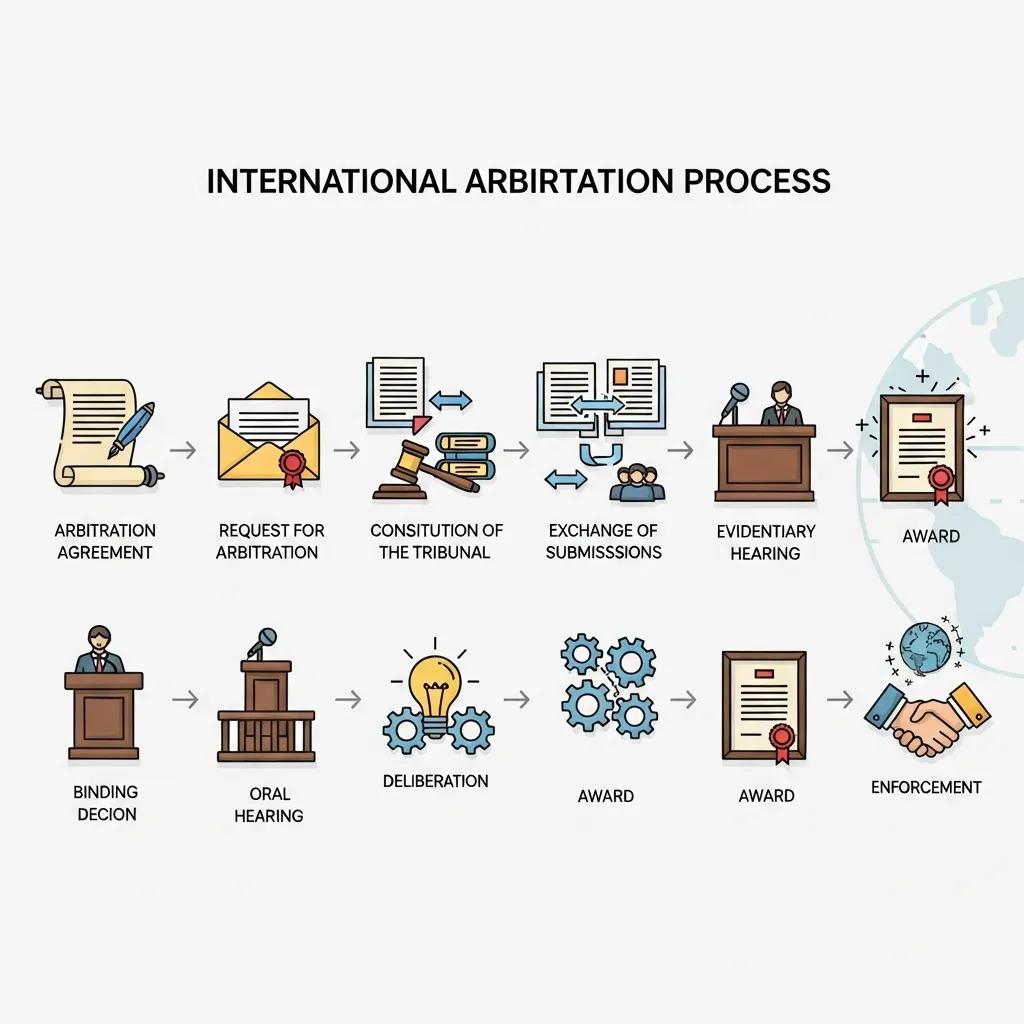
International arbitration is the structured sequence from initiating a dispute to securing and enforcing an arbitral award, designed to deliver a final, binding resolution outside domestic courts.
The mechanism works because parties contractually agree to arbitrate, select a seat and rules, appoint arbitrators, exchange submissions, and present evidence at hearings; the tribunal then issues an award enforceable in most jurisdictions under the New York Convention. The process emphasizes party autonomy, enabling tailored case management—timelines, discovery scope, language, and expert appointment—so parties can prioritize speed, expertise, or confidentiality. Understanding the lifecycle helps parties anticipate critical deadlines and procedural choices that affect enforceability and costs. The next section lists the procedural stages in order and explains typical documents and timing to help practitioners prepare an effective case plan.
The arbitration lifecycle typically follows these stages:
- Request for Arbitration / Notice: The claimant files a formal Request or Notice to begin proceedings and notify the respondent of the claim.
- Constitution of the Tribunal: Parties appoint arbitrators under agreed procedures or institutional rules; challenges and replacements occur early.
- Case Management & Procedural Orders: The tribunal issues a timetable, interim measures, and limits on evidence and discovery.
- Exchange of Submissions and Evidence: Parties exchange pleadings, witness statements, documents, and expert reports.
- Hearing: Oral or documentary hearings occur; tribunals may permit remote participation.
- Award and Reasons: The tribunal issues a final award; partial and interim awards may be issued earlier.
- Post-Award Relief and Enforcement: Parties seek correction, interpretation, or enforcement of awards under domestic law and treaties.
These stages shape tactical decisions such as seat selection and document preservation, which are explored in the following subtopics.
How is an Arbitration Initiated and What is a Request for Arbitration?
A Request for Arbitration is the formal initiating document that defines the claimant’s parties, relief sought, factual and legal basis, and the arbitration clause invoked; it triggers administrative and jurisdictional processes. The Request should clearly state the contract clause relied upon, the seat, the chosen rules, proposed arbitrator appointments, and any interim relief sought so that the respondent and administering institution can act promptly. Service requirements and timing vary by rules and seat; claimants must follow institutional filing mechanics and ensure proper notice, or risk jurisdictional objections. Common early objections include lack of jurisdiction, invalid arbitration clause, or premature filing; claimants counter these with clear contractual evidence and procedural compliance. Practical tip: include a concise chronology and supporting documents with the Request to reduce early procedural disputes and expedite tribunal constitution.
What are the Steps in Constituting the Arbitral Tribunal and Conducting Hearings?
Tribunal constitution begins with party-nominated arbitrators or institutional appointment rules and proceeds through confirmation, disclosure, and potential challenges for independence or impartiality. Arbitrator selection methods include sole arbitrator by agreement, each party appointing one member, or institutionally managed appointments under ICC, LCIA, or UNCITRAL rules; parties should vet candidates for subject-matter expertise and potential conflicts. After constitution, a case management conference establishes the procedural order, deadlines for evidence exchange, expert appointment parameters, and discovery scope; tribunals issue procedural orders to govern these matters. Hearings may be oral, documentary, or hybrid; remote hearings and witness conferencing are increasingly common and effective when planned with clear protocols. Ensure that arbitrators confirm no grounds for challenge and that any emergency relief needs are raised early to preserve interim measures.
What are the Different Types of International Arbitration?
International arbitration includes multiple subtypes—commercial, investor-state, ad hoc, and institutional—each suited to distinct parties, subject matter, and enforcement contexts. The choice among these hyponyms affects applicable rules, procedural administration, costs, and strategic enforcement considerations; for example, investor-state arbitration often invokes treaty-based protections while commercial arbitration typically relies on contractual clauses and institutional rules. Institutional arbitration is administered under bodies like the ICC or LCIA with established procedural rules and appointment mechanisms, whereas ad hoc arbitration relies on party-agreed procedures such as UNCITRAL Rules without ongoing institutional administration. Knowing these differences helps parties choose the approach that best balances cost, speed, expertise, and enforceability. The table below compares the main types, clarifying typical governing instruments, parties, and practical use-cases.
How Do Commercial, Investor-State, Ad Hoc, and Institutional Arbitration Differ?
Commercial arbitration typically arises from contractual clauses between private parties and emphasizes tailored remedies, confidentiality, and enforceability under the New York Convention; it is governed by institutional rules or agreed ad hoc procedures. Investor-state arbitration involves a private investor versus a sovereign state and is often grounded in investment treaties or concessions; it can raise sovereignty and public-policy issues and may follow ICSID or UNCITRAL frameworks. Institutional arbitration provides rule clarity, administrative case management, and procedural default mechanisms, reducing administrative friction and assisting with arbitrator appointments; ad hoc arbitration offers maximum party autonomy but requires careful drafting to avoid procedural gaps. Practically, enforcement risk and costs vary: investor-state awards may be enforced through treaty mechanisms, while commercial awards rely on domestic courts under the New York Convention; ad hoc proceedings require careful agreement on seat and enforcement strategy. Understanding these distinctions guides selection of seat, rules, and enforcement planning.
What Role Do Major Arbitral Institutions Like ICC and LCIA Play?
Major institutions supply administration, published procedural rules, appointment panels, emergency relief frameworks, and fee structures that streamline cross-border arbitration administration and reduce disputes about procedural mechanics. The ICC administers cases through its Secretariat and Court, offering a supervisory review of draft awards and well-developed rules on arbitrator challenges and joinder; the LCIA emphasizes efficient case management and clear timing provisions with transparent fee scales. Institutions differ in speed, cost predictability, procedural features, and availability of emergency arbitration; choice depends on case complexity, desired administrative involvement, and geographic neutrality. When choosing an institution, consider factors such as institutional caseload, regional familiarity, discretionary powers of the institution, and published precedents that may influence procedural expectations. Selecting the right institution early aligns case management with commercial objectives and helps minimize jurisdictional and procedural objections.
What are the Key Benefits of Choosing International Arbitration for Dispute Resolution?
International arbitration delivers several strategic benefits—confidentiality, neutrality, enforceability, procedural flexibility, and expert arbitrators—that make it attractive for cross-border commercial disputes. Confidentiality often protects trade secrets and commercial reputations by minimizing public court records, although confidentiality is not absolute and depends on rules and domestic practice. Neutrality enables parties from different legal systems to avoid perceived home-court bias by selecting a seat and arbitrators from neutral jurisdictions with agreed procedures. Enforceability is a core advantage: awards are widely recognized and enforced under the New York Convention, providing predictable cross-border remedies that litigation in a single national court may lack. Procedural flexibility allows parties to define discovery limits, evidentiary rules, hearing formats, and appointment of industry-expert arbitrators, which improves the quality of decision-making and often reduces the time needed to reach a final award.
- Confidential Resolution: Keeps disputes out of public courts, preserving business relationships and trade secrets.
- Neutral Forum: Reduces home-court advantage and supports impartial adjudication.
- Easier Cross-Border Enforcement: Awards are enforceable in many jurisdictions under treaty frameworks.
- Flexible Procedure & Experts: Parties can tailor process and appoint specialist arbitrators to decide complex matters.
These benefits inform when arbitration is preferable and how parties should shape clauses and seat choices to maximize those advantages.
Transnational Matters is a law firm aiming to promote its services in international arbitration and acquire new clients. The firm specializes in resolving cross-border disputes through arbitration, offering alternatives to traditional litigation and emphasizing expertise in enforceability, neutrality, confidentiality, and tailored dispute-resolution strategies.
How Does International Arbitration Compare to Litigation in Cross-Border Disputes?
Arbitration and litigation differ across neutrality, enforceability, confidentiality, timeline, cost, and appealability; these differences drive strategic decisions in cross-border disputes. Arbitration prioritizes party autonomy, private procedure, and generally limited appellate review, producing finality with limited judicial interference, whereas litigation provides public records, potential appellate review, and more extensive discovery in domestic courts. Enforceability favors arbitration in multi-jurisdictional contexts because the New York Convention facilitates cross-border recognition of awards, while judgments require bilateral or regional enforcement regimes and may face domestic sovereignty constraints. Cost and timeline outcomes vary: arbitration can be faster and more expert-driven for technical disputes but may be costlier in high-value cases due to arbitrator fees and institutional costs; litigation might be less expensive for straightforward local disputes. Choosing between the two requires balancing enforceability needs, desired confidentiality, complexity of subject matter, and potential for appeals.
What are the Main Differences Between Arbitration and Traditional Litigation?
Arbitration is consensual and private, offering parties substantive control over procedure, choice of decision-makers, and selection of governing law, while litigation is adjudicated by domestic courts subject to public rules and appellate systems. Arbitration awards are final with very limited grounds for setting aside, offering finality that litigation with multi-level appeals may not provide; this finality favors commercial certainty but limits appellate correction. Discovery and evidence procedures tend to be narrower in arbitration, which can reduce cost and exposure of sensitive information, whereas courts may allow broader disclosure. Enforcement of arbitral awards across borders benefits from the New York Convention, whereas enforcing judgments often requires separate recognition procedures and may face legislative or sovereign barriers. These differences guide whether parties prioritize speed and enforceability (arbitration) or appellate safeguards and public precedent (litigation).
When Should Businesses Prefer Arbitration Over Court Proceedings?
Businesses should prefer arbitration when cross-border enforcement is a priority, confidentiality is important, disputes require industry expertise, or parties seek a neutral forum to avoid perceived bias in national courts. Arbitration suits long-term commercial relationships where confidentiality and finality preserve value and allow parties to continue business ties without public litigation. Choose litigation when public precedent, injunctive remedies enforceable only in specific courts, or broader discovery and appellate review are essential to the dispute strategy. In drafting choices, consider the seat, governing law, emergency relief mechanisms, and whether institutional administration will support efficient proceedings.
- Do parties need cross-border enforceability? If yes, favor arbitration.
- Is confidentiality essential? If yes, preference for arbitration clause language and protective orders.
- Does the dispute require technical expertise? If yes, appoint industry-expert arbitrators.
- Are appellate remedies required? If yes, consider litigation or limited-appeal mechanisms in arbitration.
These considerations aid counsel in designing dispute-resolution clauses and advising business stakeholders.
How to Draft Effective International Arbitration Agreements and Clauses?

Effective arbitration agreements clearly express consent, define scope, select seat and governing law, specify rules and number of arbitrators, and include practical safeguards such as interim measures and emergency arbitrator provisions. A well-drafted clause reduces jurisdictional challenges, expedites tribunal constitution, and increases enforceability under the New York Convention and relevant domestic laws like the UNCITRAL Model Law.
The broader framework of international arbitration relies on the effective recognition and enforcement of both the initial arbitration agreements and the subsequent arbitral awards.
Facilitating Enforcement of International Arbitral Awards and Agreements
arbitral process through the facilitation of the recognition and enforcement of arbitral awards, the front end of the arbitral process through the recognition and enforcement of the parties’ arbitration agreements.
Enforcement of Arbitration Agreements and International Arbitral Awards, 2008
Drafters should avoid vague scope language, ambiguous signatory authority, or conflicting forum-selection terms; instead, use precise wording identifying applicable rules (e.g., ICC Rules), seat (city and country), governing law, and arbitrator appointment mechanics. Including express interim-relief provisions, a confidentiality clause, and a severability clause helps preserve arbitration even if parts of the contract are contested.
Further insights emphasize the critical elements and potential pitfalls in crafting and upholding these foundational documents.
Key Considerations for Drafting and Enforcing Arbitration Agreements
In conclusion, drafting and enforcing arbitration agreements require careful consideration of several essential elements and an understanding of potential challenges.
EXPLAIN THE ARBITRATION AGREEMENT: DRAFTING AND ENFORCEMENT
Below is a practical checklist and a concise sample clause useful for many cross-border commercial contracts.
- Clear consent and scope of disputes: Specify claims covered and exclude any matters if needed.
- Seat of arbitration and governing law: Identify city/country and applicable substantive law.
- Arbitration rules and institutional or ad hoc framework: Name the rules and appointment method.
- Number of arbitrators and appointment process: State single arbitrator or three-member tribunal and timeline for appointments.
- Interim measures & emergency arbitrator: Provide for urgent relief and recognize powers to seek provisional measures from courts.
A sample clause (model language) should be adapted to commercial needs and reviewed by counsel to ensure enforceability across relevant jurisdictions.
Transnational Matters is a law firm aiming to promote its services in international arbitration and acquire new clients. The firm specializes in resolving cross-border disputes through arbitration, offering alternatives to traditional litigation and emphasizing expertise in enforceability, neutrality, confidentiality, and tailored dispute-resolution strategies.
What are the Essential Elements of a Binding Arbitration Agreement?
A binding arbitration agreement must show clear mutual consent to arbitrate, identify the parties and covered disputes, and include an operational framework for appointment and seat to avoid ambiguity. Jurisdictions vary on formal requirements, but courts and tribunals typically require evidence of agreement (signed clause or incorporation by reference) and sufficiently certain terms to permit tribunal constitution. The agreement should specify governing law for substantive issues and the arbitration seat to determine procedural law and set aside standards; failing to name a seat can cause jurisdictional disputes. Including severability language and express waiver of court remedies where appropriate strengthens enforceability. Practical tip: include execution clauses and signatory blocks to demonstrate consent and avoid challenges based on authority or formation.
How to Incorporate Arbitration Clauses to Ensure Enforceability?
To increase enforceability, use precise, unambiguous wording, designate a neutral seat, state applicable arbitration rules, and include a severability clause that preserves arbitration even if other contract terms are invalid. Avoid overly broad or overly narrow scope language; instead, define covered claims and provide clear examples if necessary. Ensure signatory authority and corporate signature blocks demonstrate who consents on behalf of entities, and include express language allowing interim relief from local courts or emergency arbitrators. Red-flag clauses to avoid include conflicting forum-selection clauses, vague choice-of-law language, or clauses that limit enforcement remedies in ways incompatible with the New York Convention. Practical safeguards such as arbitration administrative defaults and procedural timelines reduce opportunities for dilatory jurisdictional objections.
How are International Arbitral Awards Enforced Under the New York Convention?
The New York Convention is a multilateral treaty that mandates recognition and enforcement of foreign arbitral awards among contracting states, providing a streamlined mechanism that significantly enhances cross-border enforceability of arbitral awards. Under the Convention, a successful party can apply to a national court for recognition and enforcement, submitting the award and arbitration agreement as primary documents; courts may refuse enforcement on limited, enumerated grounds such as public policy or lack of jurisdiction. Practical enforcement involves locating assets within contracting states, filing enforcement petitions before competent domestic courts, and responding to defenses such as invalidity of the arbitration agreement or due process concerns. Understanding the Convention’s scope, procedural steps, and common defenses is essential for converting an award into executable relief in multiple jurisdictions.
However, the practical implementation of the New York Convention can present various challenges, particularly concerning diverse judicial interpretations across jurisdictions.
Challenges in Implementing the New York Convention for Arbitral Award Enforcement
This thesis concerns the implementation of the 1958 New York Convention on the Recognition and Enforcement of Foreign Arbitral Awards (henceforth, NYC). It addresses some contemporary problems associated with the implementation of the NYC and considers the Arab Gulf states (henceforth, GCC states) as a case study to illustrate these problems. The thesis first examines how different judicial interpretations of the NYC provisions may weaken the efficiency of the well-established legal framework that regulates the recognition and enforcement of foreign arbitral awards as established by the NYC, and developed by the practice of many jurisdictions during the last fifty years.
Challenges in implementing the 1958 New York Convention: A case study of the Arab Gulf States., R Seyadi, 1958
What is the Role of the New York Convention in Award Recognition?
The New York Convention creates uniform grounds for recognition and enforcement of foreign arbitral awards in contracting states, obliging domestic courts to enforce awards except for narrow defenses such as incapacity, invalid arbitration agreement, or public policy conflicts. Its broad membership makes arbitration particularly attractive for international commerce because a single award can be enforced in multiple jurisdictions where assets are located. The Convention’s effect depends on domestic implementation and judicial attitudes; practitioners must assess local public policy thresholds and procedural formalities when planning enforcement. Practical implication: drafting clear arbitration agreements and preserving procedural fairness during proceedings reduce the risk of successful Convention defenses. Preparing certified translations and authenticated documentation streamlines court acceptance under the Convention.
What are the Procedures and Challenges in Enforcing Arbitral Awards?
Enforcement procedures vary by jurisdiction but generally require filing the award and arbitration clause with a competent court, addressing translation and authentication requirements, and responding to procedural defenses that may seek to delay or block execution. Common challenges include public-policy objections, jurisdictional challenges invoking invalidity or lack of notice, treatment of awards against sovereign states, and local rules on interim relief or attachment of assets. Effective enforcement strategy combines early asset identification, parallel relief (freezing orders or injunctions), and careful management of litigation risks in enforcement jurisdictions. Anticipate timing and cost: enforcement can be expedited in receptive jurisdictions but may face multi-year litigation in places with restrictive public-policy interpretations; counsel should prepare succinct enforcement packages and pre-empt likely defenses where possible.
Transnational Matters is a law firm aiming to promote its services in international arbitration and acquire new clients. The firm specializes in resolving cross-border disputes through arbitration, offering alternatives to traditional litigation and emphasizing expertise in enforceability, neutrality, confidentiality, and tailored dispute-resolution strategies.